|
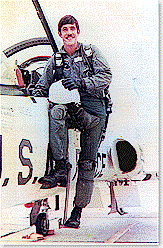
1st Lt.
Michael J. Blassie
A Biographical Sketch
Michael J. Blassie arrived on April 4, 1948 at St. Anthony’s Hospital, St
Louis. He was the first born of five children in the marriage of George
and Jean Blassie, a position from which he soon would develop the dynamic
skills of leadership. Raised in the shadow of Charles Lindbergh’s Spirit
of St Louis aircraft and as the son of an Army Air Corp sergeant who
arrived on Normandy two days after D-day, aviation made a profound impact
on Michael’s youthful aspirations. His high school athletic ability and
academic accomplishments proved fruitful as he initiated the application
process and was ultimately successful in acquiring an appointment to the
Air Force Academy in 1966. The appointment to such a prestigious
institution brought great pride to this mid-American, middle class family
steeped in traditional values of American heritage: God, country and
family.
The Academy instilled in Michael many qualities of officership, but two
characteristics stood out, responsibility and service, in particular,
service before self. As the Vietnam saga escalated and the political
dilemma divided the country, John F. Kennedy’s, "It is not what your
country can do for you, it is what you can for your country",
crystallized in this developing officer an unwavering commitment to a
cherished flag. To more clearly understand his own devotion to defend
his country and to fathom the resolve of those who choose to be her
detractors, Michael elected to major in Psychology, graduating with a
Bachelor of Science degree. Throughout his Academy years he continued to
hone the self-discipline of collegiate athletics accruing five varsity
letters in soccer and tennis. But these challenges paled by comparison
to his last summer above Colorado Springs, as he studied and sweated in
that cold mountain air learning to finesse a small intractable T-41C.
Such diligence began fulfilling those early boyhood piloting dreams.
There would be no substitute.
Graduating in the class of ’70, 2nd Lt. Michael Blassie was on the way to
fulfill a dream… undergraduate pilot training at Columbus, Miss. In
1971, following nearly a year of hard work and unrelenting study,
Lieutenant Blassie proudly displayed the symbol of his achievement upon
his chest ... the silver wings of a United States Air Force pilot.
Further short-term training to round out the skills of an A-37 close air
support warrior placed him, by January 1972, in service to his country as
a member of the 8th Special Operations Squadron, Ben Hoa Air Base,
Vietnam. On the tropical hazy, humid morning of May 11, 1972, now 1st Lt.
Michael Blassie crossed the tarmac to his assigned aircraft on his 132nd
combat mission. He and his wingman departed Ben Hoa AB and within
minutes arrived at An Loc, 60 miles further north, where enemy troops
engaged and threatened the village’s defenders. Into the maelstrom of
accurate ground fire, he flew a low-level attack against the enemy.
Lieutenant Blassie’s aircraft was hit, streaming fuel from the wings. As
his co-patriots watched helplessly over head, they witnessed Lieutenant
Blassie’s plane begin to slowly roll and finally explode upon impact
behind enemy positions. No parachute or locating beeper were observed.
It was not until October 31 that friendly ground teams reconnoitered the
area. Less than two kilometers from the A-37’s crash site and within a
ten meter radius were discovered an ejection seat, parachute cloth, raft,
flightsuit pieces, a holster, a small sum of currency, six of human bones
later identified as Caucasian, and Lieutenant Blassie’s identification
card. An ejection was evidently initiated too late, too low and from an
inverted position. 1st Lt. Michael J. Blassie was killed in action ...
serving the country he loved so dearly and in devotion to the values he
so honorably held high. The Trail to the Tomb
On May 11, 1972, 1st Lt. Michael J. Blassie was shot down by enemy
fire and killed. Due to the intense fighting associated with the Spring
Offensive, ground teams were unable to immediately reach the site
located at coordinates XT732912. However, eyewitness accounts from other pilots on that
mission reported that there was no chance of surviving the impact, explosion and fire.
Nearly six months later, on October 31, 1972, a recovery team recovered
what was thought to be 1st Lt. Blassie's partial remains at coordinates XT716906 The
recovered items consisted of six bones, Michael's identification card, MACV Form 5,
1000$RV/$5.00 MPC, part of a flight suit, an ammo pouch, a single life raft and a part of
a parachute. An ejection seat was also found 10 meters away. The recovered items were not
in the immediate vicinity of where the plane crashed.
It is plausible that as Michael's aircraft was observed to roll
inverted, an ejection sequence was initiated just seconds prior to impact at an
altitude too low for his parachute to deploy or to be witnessed. Such a scenario would
account for lack of fellow pilots observing parachute material and cords caught up in the
multi-canopied forested area of the site, the inoperability of Michael's emergency locator
beacon, and the separation between the aircraft impact site and where the remains were
found.
The remains and some effects were transported to Saigon to be
identified. On the way to Saigon, Michael's ID card and money were either
lost or stolen. There were several witnesses that reported they saw his
identification card with these remains and who signed statements to that
effect when they arrived at the mortuary in Saigon.
Because of these reports, and because the remains could not
scientifically be identified (usually through matching dental records,
x-rays or studying the stress fractures in the bones), from 1972 through
1980 the remains found with Michael's ID card were designated
"Believed to Be Michael J. Blassie." His case file number was/is
1853.
In 1980, a board met to review all relevant data pertaining to
unresolved casualties of the Vietnam Conflict and redesignated the
remains "Believed to Be Michael Blassie" as unidentifiable. It was
at that time that the remains were given the designation of X-26.
In 1973, Congress authorized the entombment of an American
Unknown Serviceman from the Vietnam Conflict to be placed in the Tomb of
the Unknowns. On Memorial Day 1984, the remains of X-26 were placed in the Tomb.
How This Information Became Available
One of the first mentions of who could possibly be buried in the
Tomb of the Unknowns came when Susan Sheehan wrote a book titled "A Missing
Plane." In it, she outlines the history of X-26, stating the remains
were of an Air Force pilot who crashed near An Loc on May 11, 1972 and then stated that
the remains were found with a piece of a flight suit, part of a
parachute, a one-man inflatable raft and a pistol holder -- all of which an A-37
pilot would carry for survival. She made no reference to any identification card, but did
state the file was X-26.
Later, in 1994, a Vietnam veteran activist wrote a story that was
published in the "U.S. Veteran's Dispatch" newsletter stating the
similarities between the case files X-26 and 1853. He declared that it was Michael Blassie
who is in the Tomb.
In 1997, CBS reporter Vince Gonzales, ran across the 1994 article and
began pursuing the information. By filing Freedom of Information Act
requests and the family consenting to allowing additional information to be made public,
Mr. Gonzales was able to create a clear and factual documented trail that links the
original Case File 1853 to X-26.
On Tuesday, Jan. 20, 1998, (the day following CBS's report) the
Department of Defense stated that the remains found in October of 1972 with
Michael Blassie's identification card are indeed the remains that are in the
Tomb. This confirmed that Case No.1853 was X-26 and that X-26 is in the
Tomb.
Q's and A's
Q: Why does the Blassie family believe the remains in the Tomb of the
Unknowns are those of Michael J. Blassie?
A: From studying military records and accounts regarding remains that were
found around the same time as Michael's identification card was, the only
other possible identities come from two other crashes. One was a helicopter
pilot and the other a C-130 crew. Neither of these types of aircraft have
ejection seats or one-man rafts. And none of them would have had
Michael's ID card. There were no other crashes that occurred in this 2,500 square mile
area.
Q: After possible DNA testing, what if the remains that were once
thought to have been believed to be (BTB) Michael J. Blassie turns out to
not be his?
A: For 25 years, the Blassie family has waited to hear the truth
about what happened to Michael. They believe that although scientifically
the remains couldn't be identified, circumstantially they could have been.
The family is eagerly awaiting the opportunity to do DNA testing and learn
the truth. If DNA testing shows the remains to be other than Michael J.
Blassie, the family would urge the government to search for this unknown's family so they
might find resolution for themselves. The Blassie family knows how important it is to have
fullest accountability of each and every one of the
nearly 2,100 who are to this day still unaccounted for. They would also be
left with the question, "Where are 1st Lt. Michael Blassie's remains?"
|
|